IT Assistance Portal



The Problem
I started by interviewing a dozen users, regular employees who had used the portal and the support staff who handled the IT support tickets, discovering that…
Employees found the IT support portal full of technical jargon and unintuitive to navigate, and they felt that the whole support process was too slow.

Help Desk needed to assign tickets to the right people, but the correct support staff might not be accurately recorded in the system, resulting in delays.
Challenges
Need to accommodate different objectives
Management wanted both big improvements to transform the portal's user experience and quick, impactful fixes to stem the tide of user complaints.
Management had a goal of promoting self-help, hence features must also be designed to communicate self-help as an option to users.
Organisational issues
The problem that Help Desk faced in assigning tickets was due to a lack of process for updating information in the support ecosystem.
Low design maturity within the organisation meant there was lack of user-centricity when thinking about internal tools.
Solutions
1: A design strategy encompassing the long and short term
I developed a design strategy to plan for quick, impactful fixes, as well as big-picture improvements to the portal.
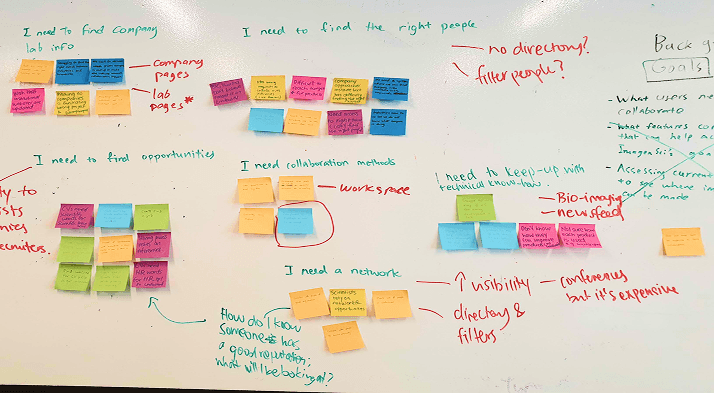
First, based on the research insights, I facilitated a session where the design team brainstormed potential improvements and prioritised them based on their impact versus time and effort required.
Next, to envision what the final user experience would look like, we assembled the solutions we had decided to work on into an ideal user journey for the IT support process.
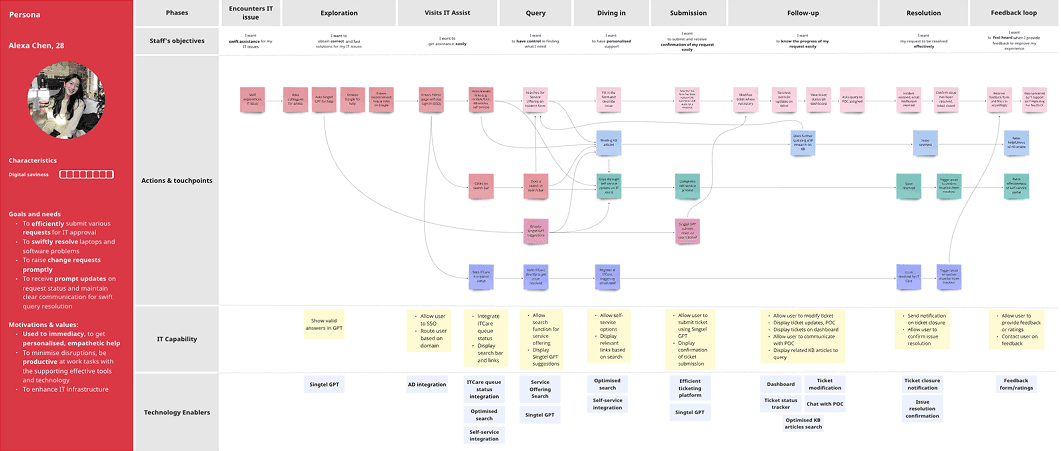
This journey map then served as the basis for our roadmap for improving the portal, encompassing both short-term and long-term improvements.
2: Process improvement and stakeholder management
To tackle the problem that Help Desk faced, I helped initiate a process improvement workstream led by an expert, which ran in parallel with our redesign efforts.

In addition, to obtain buy-in for improvements, I worked to raise the design maturity of the organisation, convincing stakeholders of the benefits of going through the design thinking process and designing based on user needs.
3: A keyword field for IT issue reporting
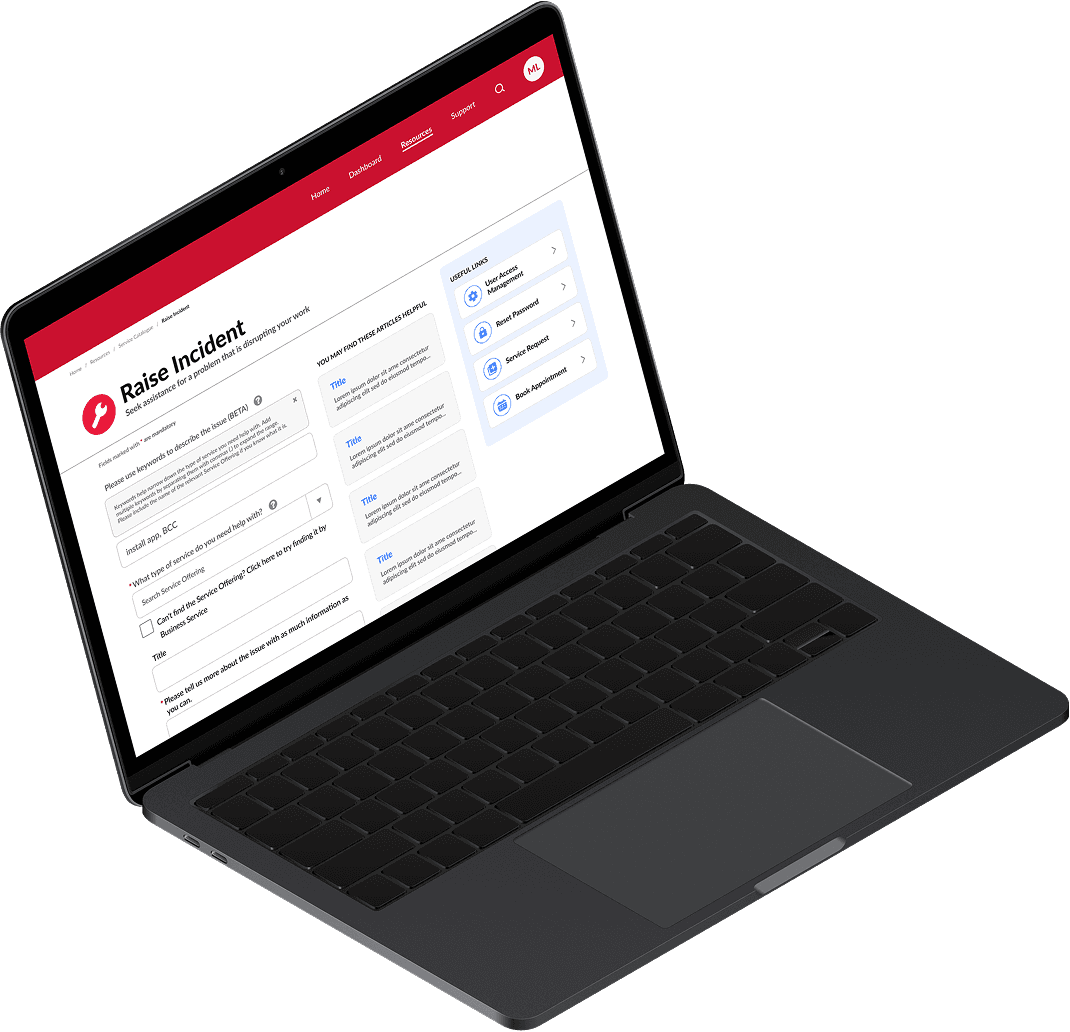
I decided to prioritise the redesign of the IT issue reporting form. It had emerged as a major pain point during the user interviews, especially when it came to picking the right category for the user's issue to ensure their ticket would go to the right person. Improving this workflow would have a large and immediate impact on the portal's UX.
In consultation with the development team, I led the design team in designing a keyword field, which would help users narrow down the right categories for their issues.
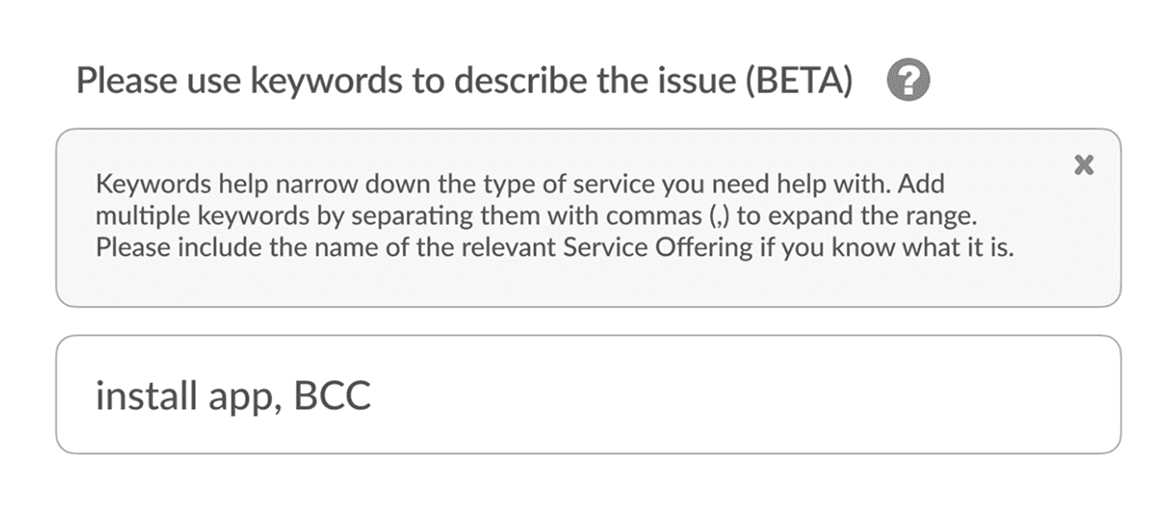
After testing an early prototype with users, however, I realised the list of recognised keywords may not be comprehensive enough at launch. Hence, I decided to have a temporary fallback flow, enabling users to go back to the old form if needed.
4: A three-column form design
With the new keyword field and management's goal of encouraging self-help, there were multiple things competing for visibility on the IT issue reporting form.
To address this, since the IT assistance portal was viewed only on laptop or desktop screens, I took full advantage of the space above the fold with a 3-column layout:
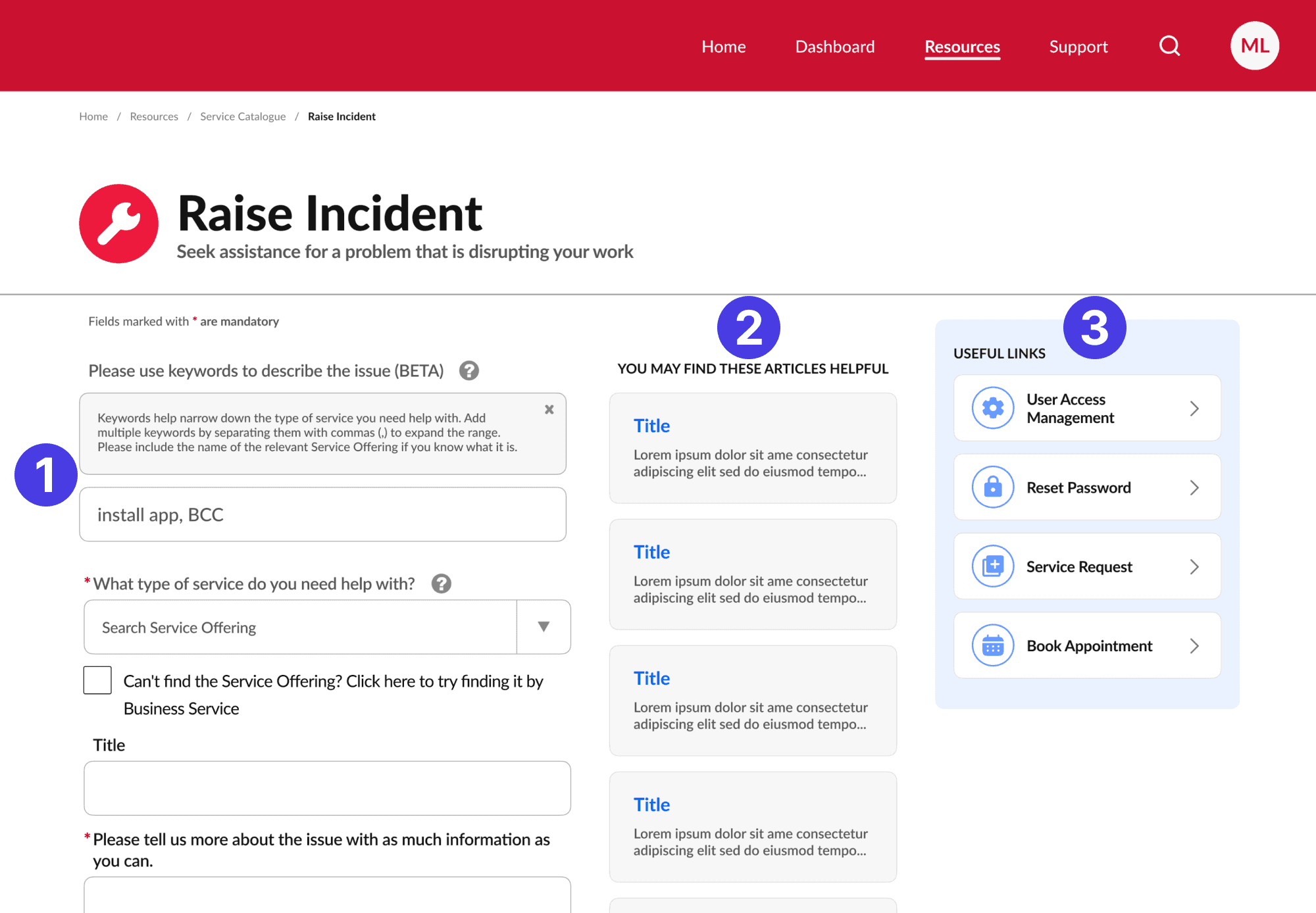
3 Links for self-help were placed in the third column, also at the top of the page to be easily seen.
Outcome
After finalising the new form design, I worked with the development team to create a test version and led comparative user testing of the old and new forms.
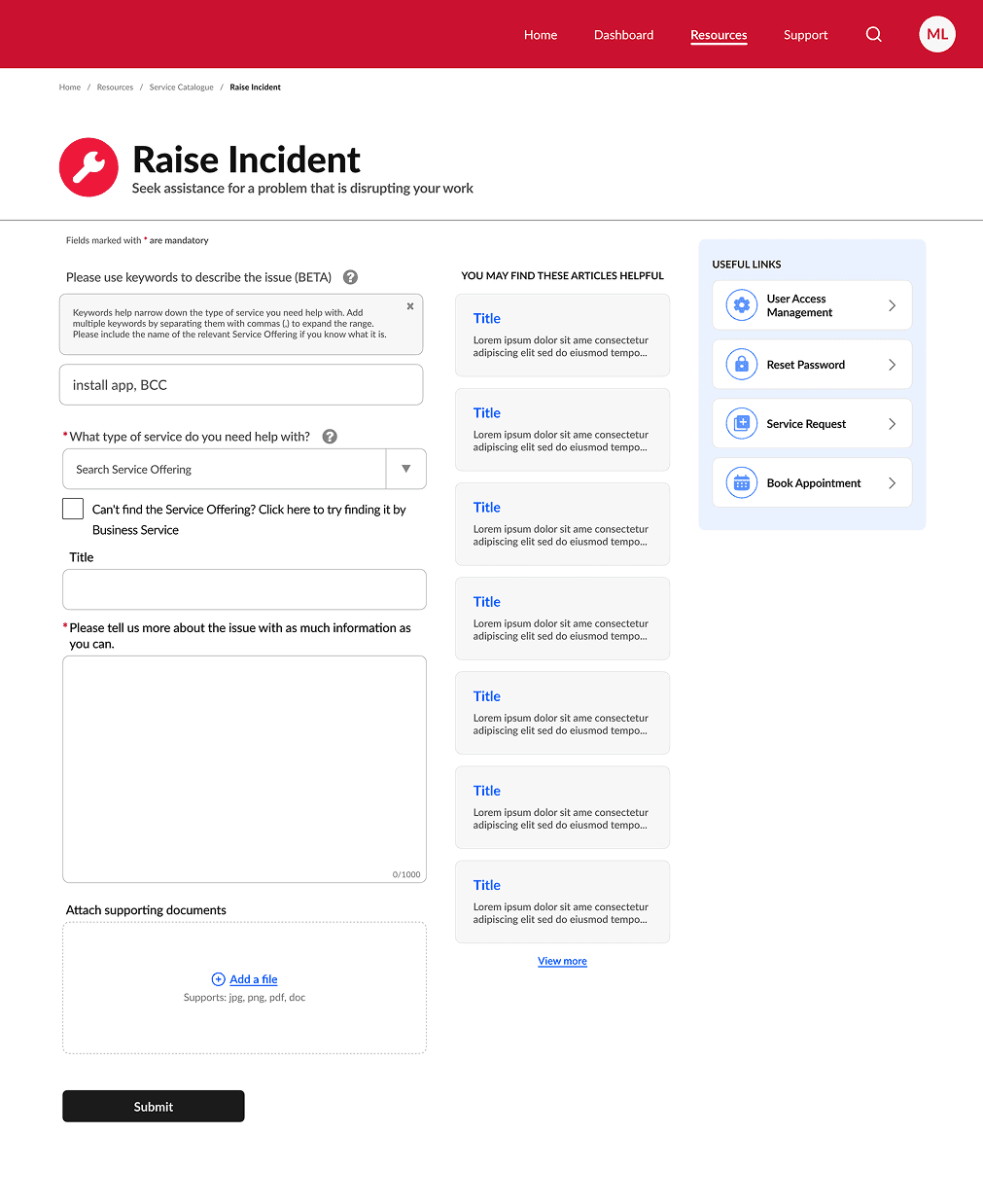
The new IT issue reporting form
The results showed a 35% increase in users successfully completing all fields on the new form, a significant increase indicating improved usability.
Reflections
However, after the new form had passed UAT, senior leadership decided to delay its launch in favour of a larger portal revamp, breaking from the approach of starting with tactical improvements and making incremental changes to the portal.
On hindsight, I had been too focused on demonstrating the improvements that we were making. If I had also presented a holistic case on the impact of these improvements, we might have been able to get a green light for the form’s launch.